Wednesday, December 14, 2011

The Dragonfly Pool Part II

Genre: This book is Juvenile fiction but as i said before any age can enjoy it. I would mark it as an Adventure story.

Style: This book has a very happy atmosphere. It's one of those that just plain make you smile. 

Romance: When I read a book I like to know exactly how much romance there is in it. The romance in this book is minimal. There is an engagement at the end of the book but there is no kissing and the engagement is sort of understood. No one even says the words "will you marry me?"

Rating: 8.5 out of 10. 

Wednesday, December 7, 2011

The Dragonfly Pool: By Eva Ibboston Part I

First of all we need a disclaimer. I do not endorse all of Eva Ibboston's works in fact I know of only three that are not fantasy. However these three are masterpieces. The height of what children's literature should be. 

Age level: I would say that this book belongs to to the 10 and up group. I first read it when I was just barely 13. My sister who is 16 enjoys this book as much as I do. So now, enough about how it's OK to read this if you're in your teens.

Story Line: Tally lives in London with her Dad who is a Doctor and two great aunts. She loves London and all the people she knows there. Then a patient of her fathers gets her a scholarship to Delderton a school in Devon in the south of England. This is good because war is coming and if the Nazi's start bombing London Tally's father wants her far away and safe. It's bad because Tally really wants to stay. Plus her snooty cousins seem to think there is something wrong with Delderton and they aught to know they are authority's on boarding schools. Full of misgivings Tally goes and loves it! Delderton is a wonderful place: no uniforms, friendly teachers, wonderful students, and a very special tutor called Matteo. Tally makes lots of friends so when a chance to go to the tiny country of Bergania as a dance team she rallies her friends and gets up a dance for them to do. Bergania is even more awesome then she expected. But the wonder doesn't last, The Nazi's invade Bergania and Tally and her friends are the hope for the young prince.

Main Characters:
  • Tally: Daughter of Dr. Hamilton and the protagonist of this book. She is determined kind and caring. She will do anything for a friend and is as loyal as can be. She has a habit of taking care of everyone from a dachshund to a prince. 
  • Karil: Prince of Bergania. He is put upon and scolded with in an inch of his and he hates being a prince.  His father is his favorite person. He is a bit unsure and needs a friend more then anything else. Karil is my favorite character next to The Scold of course. 
  • The Scold is the privet name Karil gives to his governess the Countess Frederica she is stern and she always wears black and never smiles. She really loves Karil and in the end of the book they even become sort of friends she just has a rather funny way of showing it.       


Tuesday, November 1, 2011

Queen's Own Fool

As the woman got closer, the half-moon cast her in a pale light so that she looked like a fairy queen. Instead of a crown of jewels, she wore a hood with a heart-shaped curve above the forehead, from which her auburn hair peeked out. It was Queen Mary herself, alone and without escort.
~Queen's Own Fool

Queen's Own Fool by Jane Yolen and Robert Harris is historical fiction at its best. It's the story of Nicola Ambruzzi, the real-life jester for Mary, Queen of Scots. Very little is known about Nicola--but isn't she the type of character that's perfect for a historical novel? The story of Queen's Own Fool is part fiction, part fact--and it's hard to tell where one leaves off and the other begins.

Nicola Ambruzzi, an Italian orphan, is traveling France with her uncle's family, a group of traveling players. They are fortunate enough to land an audience with the new king of France and his wife, Mary Stuart. When Nicola runs into Queen Mary in the castle garden after the performance, the queen is captivated by Nicola's wit and hires ten-year-old Nicola as her personal fool. Nicola and the queen quickly become friends, and it is Nicola alone who can comfort the queen after the loss of her beloved husband Francis.

After Francis dies, the queen must leave France and return to her native Scotland--connected to the French throne only through marriage, she no longer has any need to remain in France. So she sets off for Scotland, accompanied by Nicola and her four ladies-in-waiting (all named Mary, which can be a bit confusing). Scotland welcomes its queen with open arms, but this isn't a happily ever after. A sweet Italian musician (David Rizzio), a thunderous, fiery Protestant reformer (John Knox), a cruel and strict tutor (Madam Jacqueline) and a suave and charming young lord (John Willoughby Henry Darnley) have yet to meet Mary Stuart and Nicola, and the story becomes more exciting with every page.

This is historical fiction at its best. As I said, it's extremely difficult to tell where fact leaves off and fiction begins. The authors wove history in with their story so expertly that I put down this book knowing far more about Scotland in the 16th century than I had ever hoped to know (and this from a girl who read Dear America's Royal Diaries series when I was in fifth grade as if they were going out of style). I highly recommend this fascinating novel!

9 out of 10 stars. Recommended for ages 12 and up (there are a couple of scenes that might be frightening for younger readers, especially a part about persecution of the Huguenots).

Thursday, April 21, 2011

What Do You Like To Read About?

Attention, all readers of Reviewers' Bookshelf! We are taking a brief hiatus from our normal program in order to inform you of a poll being taken at this blog.

Reviewers' Bookshelf is a blog created for the enjoyment of people who love books. We love books, and we know you do too. We enjoy reviewing books that we've liked, and we like reading what you have to say about books you like.

But we want to know what kind of books you like. We want to know what YOU would like to see on Reviewers' Bookshelf. We'd love it if you, even, would like to review a book or two for others' benefit.

A few months ago we had a poll on the sidebar, asking readers what kind of reviews they enjoyed. This was good, but it really didn't give us a whole lot of feedback. So we're going to do something a little different. We're asking you to comment on this post and give us your opinion. Please don't be shy! We really want to hear from you. You don't have to give out any kind of personal information. Just share with us what kind of book reviews you'd like to read, and whether or not you would be willing to write a few reviews for the Common Good of All Readers of Reviewers' Bookshelf.

Thanks so much--looking forward to hearing from you!
~Amy and Carolyn

Wednesday, April 13, 2011

The Scarlet Pimpernel by Baroness Orczy

"A surging, seething, murmuring crowd of beings that are human only in name, for to the eye and ear they seem naught but savage creatures, animated by vile passions and by the lust of vengeance and of hate." ~The Scarlet Pimpernel

The above quote isn't particularly inspiring or funny or even profound--it just amuses me because it is the first sentence of the book, and it does not contain a verb. No, seriously. Read it again and you'll see.

The Scarlet Pimpernel, written in the early 20th century by Baroness Emmuska Orczy, can rightfully be called one of the greatest adventure stories of all time.

In the mid-1790's, when the French Revolution was at its height, hundreds of aristocrats were dying under the guillotine. The new Republic advocated liberty, equality and fraternity, but in reality it was a reign of terror. During this horrible time, one man was risking his life and leading a band of his like-minded friends to save those in danger. French and English alike gratefully reverenced him, yet only those in his band of rescuers knew his name. To the rest of the world, he was known only as the Scarlet Pimpernel.

Marguerite St. Just Blakeney, "the cleverest woman in Europe", sympathized with the Scarlet Pimpernel's actions, yet she herself had once been responsible for sending an entire family of aristocrats to the guillotine. Marguerite, married to the foppish idiot Sir Percy Blakeney, now regretted her hasty action in denouncing the Marquis de St. Cyr and his family, yet now there was nothing she could do. So she lived in glamour and luxury in London and pretended to forget what had once happened in France.

That is, until Monsieur Chauvelin, a member of the Republic who bitterly hated the Scarlet Pimpernel, appeared with a threat for Marguerite. Tipped off by his spies, Chauvelin learned that Marguerite's brother Armand was in league with the Scarlet Pimpernel, and used this information to blackmail Marguerite into helping him find the Scarlet Pimpernel.

Threatened with the death of her brother if she did not comply, Marguerite agreed to help Chauvelin, but that was not the end of the story. Marguerite had no idea of the real Scarlet Pimpernel's identity. If she had, she never would have allowed herself to be roped into Chauvelin's devious plan...

I better stop there before I give away too much of the plot. This is an excellent book, worthy of nine and a half stars out of ten. There are only two things about the book which I do not like, and they are the only elements keeping it from receiving ten stars:

1) The author spends too much time praising Marguerite's beauty. It would only take a few lines to describe Marguerite for us, yet Baroness Orczy takes up almost a quarter of the book raving about Marguerite's fair skin, shining hair, luminous eyes, etc. We get the picture, Baroness. Please move on.

2) The language. Sir Percy frequently uses words that are not acceptable in polite company (although it's nothing obscene). For this reason, I wouldn't recommend the book to children under 12.

All in all, this is a great novel! You can read it online at Project Gutenberg, and also at ScarletPimpernel.com. The website I linked to is easier on the eyes than Project Gutenberg, so you might prefer that. Also, it's a classic, so it should be available at most libraries and bookstores.

I've read the book several times, but never seen a movie version of it. I've heard that the 1982 adaptation, starring Anthony Andrews and Jane Seymour, is supposed to be outstanding, and I'd like to see it. Have you seen it? Do you recommend it?
~Amy

Wednesday, February 16, 2011

Jane of Lantern Hill by L.M. Montgomery

"Life, deal gently with her... Love, never desert her." ~Jane of Lantern Hill

Jane of Lantern Hill is one of my favorite L. M. Montgomery novels. Set in the late 1920's, it was one of her later books, and maybe that's a good thing. The story is light and well-paced, the characters are as endearing as her earlier Edwardian novels, but the book lacks the endless descriptions and flowery poeticism that are so prevalent in the Anne books. Not that the descriptions are necessarily a bad thing...


I'm getting off topic. Jane of Lantern Hill centers around an eleven-year-old girl named Jane Stuart, who lives with her mother, her aunt Gertrude, and her grim, austere grandmother at 60 Gay Street in Toronto. Grandmother and Aunt Gertrude rarely smile, but Jane and her mother get along beautifully--and of course there's Jody, the little girl next door, Jane's best friend. All her life, Jane has believed her father was dead... until a girl at school reveals the awful secret: Jane's father is alive and well, living in a remote little place called Prince Edward Island. And things only get worse when her father, out of the blue, writes to say that he wants Jane to come spend the summer with him. Summer on a tiny little island away from Mother, with a father she's never met and doesn't want to meet? Jane is sure that the next three months will be agony.

She's in for a real surprise. PEI is not only a beautiful place, it's a friendly place. Jane and her dad get on fantastically from the beginning, and Jane makes dozens of new friends. She learns housekeeping in Dad's little cottage, teaches herself to swim in the dazzling blue gulf, develops a liking for cats, and manages to capture an escaped lion. But she can't be perfectly happy, because she knows Mother is far away in Toronto, missing Jane tremendously. Why on earth did Dad and Mother ever separate in the first place....?

This book is a delightful read, and I heartily recommend it! Jane is one of those heroines who is almost real; she's the kind of girl I'd like to have for a friend. The book is probably best for ages 10-16, and it's available through Borders, Barnes and Noble, and the Lancaster County Library System. I'd rate it a nine out of ten.

Saturday, February 12, 2011

Wives and Daughters by Elizabeth Gaskell

Wives and Daughters is one of those beautiful, timeless, endearing and enduring classics that is unfortunately "on the back shelf", so to speak. It is more popular than some of Elizabeth Gaskell's other novels (North and South, Mary Barton) but it doesn't have the recognition it deserves. Written in the early 1860's, the story takes place some thirty years earlier.

Seventeen-year-old Molly Gibson, the heroine, lives in the fictional town of Hollingford with her widowed father. They are happy together and have a close, warm relationship. But Dr. Gibson feels that Molly ought to have a mother, and so he asks Mrs. Kirkpatrick, a middle-aged widow, to marry him. The new Mrs. Gibson is kind to Molly, but she doesn't understand her, and Molly wishes things could be as they were before. Molly gets on better with her new stepsister, Cynthia Kirkpatrick, but the two girls are very different. Meanwhile, Molly strikes up a friendship with the Hamley family (hey! it rhymes!) of Hamley Hall: the elderly Squire Hamley, his delicate wife, and their two sons, the poetic Osborne and the studious Roger. When Mrs. Hamley dies after a lingering illness, Molly becomes even closer to Squire Hamley; he looks upon her as a daughter. She and Roger also become very close, sharing a love of nature and science.

But then things begin to happen very fast when Molly accidentally discovers Osborne Hamley's deepest secret. To make matters worse, Roger Hamley falls in love with Molly's stepsister Cynthia and proposes to her--just before he leaves for a two-year journey in Africa. Then Molly begins to fear that Cynthia has a secret of her own, involving Mr. Preston, the local land-agent...

I won't tell any more, because I don't want to give away the whole plot, but I will say that it is the kind of story you can't put down. I read it in November 2010, but didn't get around to writing a review until now (shame on me). The characters were so real and vivid, the narrative well-paced and interesting, and the dialogue enchanting. Dr. Gibson, in particular, was extremely funny!

I'd recommend this book for ages twelve and up, and rate it nine out of ten--I withhold the tenth star only because the novel isn't finished! Yup, that's right. Mrs. Gaskell died before she finished writing this, her last book (well, obviously it was her last book). But it is evident how she intended the story to end, and you aren't really left hanging at the last page. I would recommend watching the 1999 BBC miniseries based on the novel, with Justine Waddell and Keeley Hawes. It does a nice job of tying up the loose ends and finishing the story.

This book is in the public domain, so you can find it on Google Books or Project Gutenberg. I also have a copy of it, so if anyone in my area would like to borrow it, please let me know!
~Amy

Tuesday, October 12, 2010

Little Dorrit by Charles Dickens

Little Dorrit is arguably Dickens' best novel. Published in serial form between 1855 and 1857, the story centers upon a a timid seamstress named Amy Dorrit. (This is one of the few Dickens books with a girl for a main character!)

Amy Dorrit, better known as Little Dorrit because she is so petite, was born in the Marshalsea debtors' prison. Her father, William Dorrit, was imprisoned for debt shortly before she was born, and she has lived in the prison for all of her twenty-two years. Her mother died when she was born, and her two older siblings--Fanny and Edward ("Tip") are self-centered and irresponsible. So it falls to Amy to take care of her father and provide for him. Her father, though in reduced circumstances, retains his pride and will not ever let anyone think that he is less than a gentleman. Amy works as a seamstress for the elderly Mrs. Clennam, but her father is not aware of this fact. (Or, if he is aware, he refuses to acknowledge it.) Fanny is employed as a dancer in a music hall, and Tip spends his time loafing and gambling.

At the same time, Arthur Clennam is returning from twenty years' work in China with his merchant father, who has just passed away. Before Mr. Clennam died, he handed Arthur a mysterious gold watch with the words Do Not Forget etched into the back, and instructed Arthur to give the watch to his mother. Arthur has no idea what the watch signifies, but he suspects that his father--and the House of Clennam--once did someone a great wrong, and he is determined to put it right.

Meanwhile, in a criminals' prison in Marseilles, France, an evil man named Rigaud has just been released from his cell. He is suspected of murdering his wife, but the court lacked evidence, so he has been acquitted. His little cellmate, Cavalletto, is the only person to whom he admitted his crime. Cavalletto, frightened to death of this man, swears to keep silent.

Arthur returns the watch to his mother, but she refuses to explain its meaning to him. Angered, Arthur leaves the family business, but he takes an interest in the young woman working for his mother: Little Dorrit, the daughter of a Marshalsea prisoner. Could it be possible that Arthur and Amy's families are linked....?

Then, of course, there's Arthur's childhood sweetheart Flora Finching, who hopes to rekindle an old flame. There's the Meagles family, with their spoiled daughter Pet and their put-upon adopted daughter Tattycoram (who is dissatisfied with her life and wants nothing more than to get away). There's Mr. Pancks, the universally disliked rent collector at Bleeding Heart Yard, and his two-faced employer Mr. Casby. There's Daniel Doyce, an aspiring inventor who goes into partnership with Arthur. There's the Circumlocution Office (occupied by the illustrious Tite Barnacle and family), a highly inefficient branch of government that refuses to accept Daniel Doyce's patents.

This two-volume novel teems with subplots, dozens of fascinating characters, and subtle satire on English society in the 1840's. If you're like me, you won't be able to put it down as you follow Amy Dorrit and her family from poverty to riches, through foreign countries, in and out of mysterious dealings with people-who-are-not-as-they-seem, to a happy ending at last. An excellent book--no, a wonderful book! I give it nine stars out of ten, recommended for ages thirteen and up.

You can read Little Dorrit on Project Gutenberg, or find it at your local library. It's a classic, so it's pretty easily available. I own this book, so I'd be happy to lend it to anyone who wishes to borrow it. (And when you finish the book, don't miss the 2008 BBC miniseries based on the novel. It's fantabulous!)

Thursday, February 18, 2010

Hidden Rainbow by Christmas Carol Kaufman

Originally published in 1957, this book could easily be counted as a classic. Christmas Carol Kaufman (yes, that was her real name) was a prolific Christian author in the 1930's, 40's, and 50's, and I think Hidden Rainbow is her best work.

The story is set in the beautiful Yugoslavian countryside, about 1900. John and Anna Olesh, a newly married peasant couple, have lived their whole lives in the little village of Miletinac under the authority of the Roman Catholic church. Hoping to get some economic opportunity elsewhere, John takes a trip to America despite the villagers' disapproval. When he returns, no wealthier than before he left, the little family is struck by trouble. John and Anna's three-year-old daughter, Mary, falls and splits her kneecap, and no one in the village (not even the witch doctor) can help her. In the middle of all this, a traveling Protestant minister, Mr. Lutz, visits the village. John and Anna are not sure whether to be friendly to this seemingly harmless man, or to remember the Catholic church's warnings against Protestant heresies. They hesistantly give Mr. Lutz a meal, but refuse to accept one of his New Testaments--that is going too far.

Hoping to find a cure for Mary's knee, John sets off for America again. While he is gone, Anna succumbs to curiosity and the need for some answers, and she accepts a New Testament from Mr. Lutz. But the Catholic church at that time forbade the common people to read or even handle God's Word. Should Anna and John keep the book hidden and read it secretly, hoping to discover the truth, or should she burn it? Will the priest find out? And is the mysterious little book worth going against everything John and Anna have been taught?

Hidden Rainbow is a thought-provoking, sad, joyful, exciting, and poignant look at the power of God in two people's lives. Best of all, the story is based on the lives of real people. I would give it ten stars out of ten!

Friday, February 12, 2010

Faithful Women and Their Extraordinary God, by Noel Piper


I love reading about people from history who loved the Lord and were devoted to serving Him! This book introduces us to five faithful women who trusted God: Sarah Edwards, Gladys Alyward, Lillias Trotter, Esther Ahn Kim, and Helen Roseveare. Using the journals and letters of these five ordinary women, Mrs. Piper shares the exciting stories of how God used them for the advancement of His kingdom. I have not yet finished the book, but already I have been blessed and inspired to follow the Lord more closely and devote my entire heart and life to His glory! I hope to emulate each one of these women, even as they emulated Christ. If you are looking for an encouraging read, I would highly recommend this book!
This book is available to read for free online here or you can purchase it hard copy at the same website.

~Jenny F.

Tuesday, January 26, 2010

The Bronze Bow


He trains my hands for war so that my arms can bend a bow of bronze...Daniel a Jewish boy living in the time of Jesus takes this verse as motto. His hate for the Romans and vow to get even for the death of his parents keeps all happiness out of his life, he joins up with a robber band that is planning to oust the romans there he learns how to rade and plunder, and fans the fire of hate he has in his heart . Daniel meets the Messiah and makes friend with the son of a scribe and Jesus shows him a path of love and forgiveness instead of hate... But what about that bow of bronze? And his vow of revenge to the Romans? If he gives it up what is there to live for? And if this man is the Messiah when is he leading the revolt? The Romans are to be hated. Or are they? Is Jesus way of forgiveness really better? Is the Bow a Bow of Love not hate? I love this book and would really like your comments on how you liked it.

Saturday, January 23, 2010

Mama's Bank Account by Kathryn Forbes

The story of Mama's Bank Account may be better known as the classic film I Remember Mama. It is the true story of Lars and Marta Hansen, immigrants from Norway who live in San Francisco in 1910. Told through the eyes of the eldest daughter, Katrin (Kathryn), the book is a series of delightful vignettes about the Hansen family--Mama especially. Whether she's pinching pennies for the monthly rent, wangling her way into the hospital to visit her sick daughter, or attempting to cure a badly injured cat, Mama is not the kind of character you can easily forget.

Though there isn't really any strong plot throughout the book, it's a wonderful read--interesting, funny, and heartwarming. I would give it eight out of ten, probably for readers 11 or 12 and up. Check out the movie, too, it's also very good.

~Amy

Monday, January 18, 2010

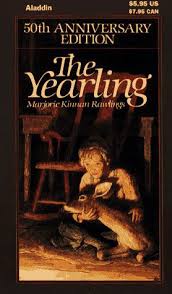
The Yearling by Marjorie Kinnan Rawlings


The Yearling is our family's all time favorite book. Written in 1938, the story takes place in early 20th century backwoods Florida. Jody (a boy) lives alone with his parent on their subsistence farm. He is the youngest of seven children, but the only one who survived. Jody always wanted something of his own and early in the story he adopts an orphaned fawn which he nurses and raises. In time the fawn grows up to start eating the food the family needs to survive and Jody must make some serious "growing up" choices.

The characters in this story are very real and there are many heart rending moments between Jody, his parents and his best friend (whose odd name is Fodder wing). I don't want to say too much for fear of ruining the story. Our family read this book out loud together and it is standard to which every other book is compared. If there is such thing as a 10 out 10 book, this is it.

The Yearling was also made into a movie with Greogry Peck and Jane Wyman, but the book is really worth reading. As the book won a Pulitzer prize, I can't imagine there is a library anywhere in the English speaking world that wouldn't have at least one copy of it.

Enjoy!!

- Thomas G.

Friday, January 15, 2010

Eight Cousins by Louisa May Alcott

Everybody has read (or at least heard of) L. M. Alcott's classic story Little Women, as well as its sequels, Good Wives (sometimes called Part Two of Little Women) Little Men and Jo's Boys. But these were not the only books Alcott wrote--she penned a total of twelve novels and numerous short stories in her lifetime. These lesser known books include Eight Cousins, Rose in Bloom, Jack and Jill, An Old-Fashioned Girl, Under the Lilacs, Aunt Jo's Scrap-bag, The Quiet Little Woman, and A Garland for Girls.

One of my favorite classic books is Eight Cousins. Originally published in 1875, it tells the story of Rose Campbell and her seven cousins. When the story begins, Rose's father has just died, leaving her an orphan (her mother passed away when she was a baby) and under the guardianship of her Uncle Alec. Rose has been spoiled at a snooty young ladies' academy, and Uncle Alec (who is a doctor) has decided to "retrain" her--she learns to do housework, eat oatmeal, study physiology, wear flannel and bloomers instead of silk and corsets, and--gulp--go camping with her boy cousins instead of doing embroidery.

This book doesn't have an earthshattering plot, but it's hard to put down. Rose's change in attitude and personality is slow but sure--at the beginning of the book she's rather selfish and vain, and by the end she's changed into the kind of little girl Dr. Alec wants her to be. Eight Cousins is also full of interesting characters that seem very real. I would give this book eight stars out of ten! It's probably best for readers 10-16. Have you read Eight Cousins? If so, what part did you like best?

PS I own this book, if anyone is interested in borrowing it. It is also available through Borders, Barnes and Noble, Amazon.com, the West Davidson County Library and the Lancaster County Library System.

Wednesday, January 13, 2010

Johnny Tremain by Esther Forbes

Johnny Tremain a silversmiths apprentice is the proudest boy in Boston. He looks down on the other apprentices he is gifted and he knows it. Johnny has plans of being a great silversmith until an accident with a crucible leaves him without the use of his right hand. Trying to find work he finds himself in trouble with the Loyalist Mr. Lyte, riding a wild horse for a newspaper, and being the messenger for the secret patriot group the Boston Observer Club this job brings him in contact with Hancock, John and Samuel Adams, and other patriot leaders. He gets to take part in the famous Boston tea party and spy for the patriots.
I love this book I would rate it 10.
~Carolyn

Tuesday, January 12, 2010

Princess in Calico ~ Author Unknown


"Blessed be drudgery, for it is the gray angel of success"

  The story focuses on a seventeen-year-old girl, Katura, who lives on the family farm, a life of dudgery and hardship. One day, she receives a letter from her cousins in Boston, asking her to come for a long visit. With only $10 for the "absolute essentials", she prepares and leaves for the trip. Her cousins are greatly influenced by her diligence and innocence, and absolutely adore her. While in Boston, Katura meets Tryphosa, a wonderful Christian. Although an invalid, with constant terrible pain, Tryphosa always has a song. Katura is greatly influenced by Tryphosa and gives her life over to the King.
She is planning to attend school in the city in the fall, and is excited about her life. Things are looking so bright...then the letter arrives. Her step-mother, who had been so unpleasant to Katura in the past, has had a stroke.

  Her world was so bright...now things are quickly growing dimmer. Will she, instead of searching for happiness, seek harmony with her King?

  Although short, this is one of the best books I have ever read. I highly recommend it without any reservations! Nine out of ten stars...I have read it several times, and have enjoyed it immensely every one. I have a copy, if you would like to borrow it. Also, you can read it online here on Project Gutenberg, and you can find it for sale here at Rod and Staff.

EDIT: Forgot to say, this book is probably best for girls age 12 + up :)

~Mattie

A Body of Divinity, by Thomas Watson

Thomas Watson was a Purtian non conformist in Civil War era England. He was a contemporary of John Bunyan. His book A Body of Divinity is one of the most easily read of all the works of the Puritans. In it he explains with a heart overflowing for love of Jesus Christ, the doctrines of the reformed faith. He uses as his outline the Westminster Shorter Catechism, but each chapter (which is actually a sermon) is delightful to read and wonderfully edifying.

I realize this blog is more geared towards works of fiction, but if you are looking for a good book to lift your spirits in devotion to the Lord, I highly recommend Thomas Watson's A Body of Divinity. It might be a little rough on younger teens, but really anyone with a heart for the Lord should be so taken with this book that it will be hard to put it down.

The book is currently published by Banner of Truth (http://banneroftruth.org), but you can also read a copy of it online at (http://www.iclnet.org/pub/resources/text/ipb-e/epl-10/web/watson-divinity.html)

-Thomas G.

Miss Spitfire: Reaching Helen Keller by Sarah Miller


I read this book for the first time on Saturday and it goes in my list of great books. It covers the story of Anne Sullivan's struggle to teach Helen Keller. Helen is spoiled by her parents and has no concept that there are such things as words; she is little more then an animal... until Anne gets there. Fighting against the Keller family's want of "no discipline", Anne can't get through to Helen emotionally. Can she show Helen the wonder of words some other way? Here is an excerpt from Miss Spitfire...
Yet a part of me understands Helen better then she does herself. I am no stranger to frustration, anger, isolation. I wonder, though, how Helen can be content to deprive herself of my affection? The thought of her indifference makes my throat sting, yet I cannot help but feeling drawn to her. If I only touch her heart I know I could Touch her mind. But she won't even let me touch her hand.
A small voice inside me cries I want to go home. Another answers. What Home?
I got this book through the Lancaster County Library system. I would give this book a number 10 rating. This book was probably the fifth I read on this subject but it was just as exciting to read about. The change Anne and Helen both go through is amazing.
~Carolyn

Not My Will by Francena H. Arnold

Subtitle: How much will surrender cost?


This book, originally written "just for the family" by a stay-at-home mom in the 1940's, has now sold over 50,000 copies and, I think, is worthy to be counted a classic. I would give it nine stars out of ten--it's the kind of book that you want to read again and again.

The story revolves around Eleanor Stewart, an orphan who lives with her wealthy aunt Ruth. Aunt Ruth is a stern disciplinarian, but she and Eleanor get along tolerably well. Eleanor has an interest in medical research, and hopes to pursue a career in that direction. While she is in college, her aunt becomes very sick and dies. She leaves all her money to Eleanor--but there is a catch. Aunt Ruth wrote in her will that she would like Eleanor to use the money for research. Eleanor would inherit the money on her twenty-fifth birthday, but only if she did not get married before then. When Eleanor first learns of this, she is content to wait...but then she meets and falls in love with Chad Stewart (yes, they share a last name). Now Eleanor is faced with a struggle. Should she marry Chad and forget about the inheritance, or wait to marry him until after her twenty-fifth birthday? Or could they be married secretly?

Eleanor thinks she has all the answers, but she didn't reckon with God. When tragedy strikes and a sudden plot twist enters, she is forced to give up everything she had counted on. Is she willing to submit her life to Christ, no matter what the consequences?

This book has all the best characteristics of a truly good book: lifelike characters, a gripping plot, engaging writing, and, best of all, a happy ending...but I won't spoil it for you.

I own a copy of Not My Will, so if you would like to borrow it, let me know!
~Amy

Monday, January 11, 2010

The Railway Children by E. Nesbit


This book is one of my personal favorites. I would rate it 9 out of 10.
The children's (Roberta, Peter, and Phyllis) father goes off on "business" and they and their mother move out to the country near a railway station, where they make friends with the porter Perks, a hound in a red jersey, and a Elderly Gentleman who is extremely kind. Just talking about this book reminds me that I need to read it again. My favorite character is Perks the porter, he has a delightful accent and is very funny.
-Carolyn